

Digital Product Passport (DPP) Compliance Guide
The Digital Product Passport (DPP), introduced as part of the European Union’s sustainability vision, is no longer an option for businesses but is becoming a legal requirement. This guide outlines the roadmap your business should follow to comply with the new regulations.
3 Key Requirements for Being DPP-Ready
For a business to be considered fully DPP-compliant, it must meet the following three requirements:
Unique Identification: Be able to assign a unique identifier to each product unit.
Data Record: Link this identifier to a machine-readable record containing all technical and sustainability data required by the industry.
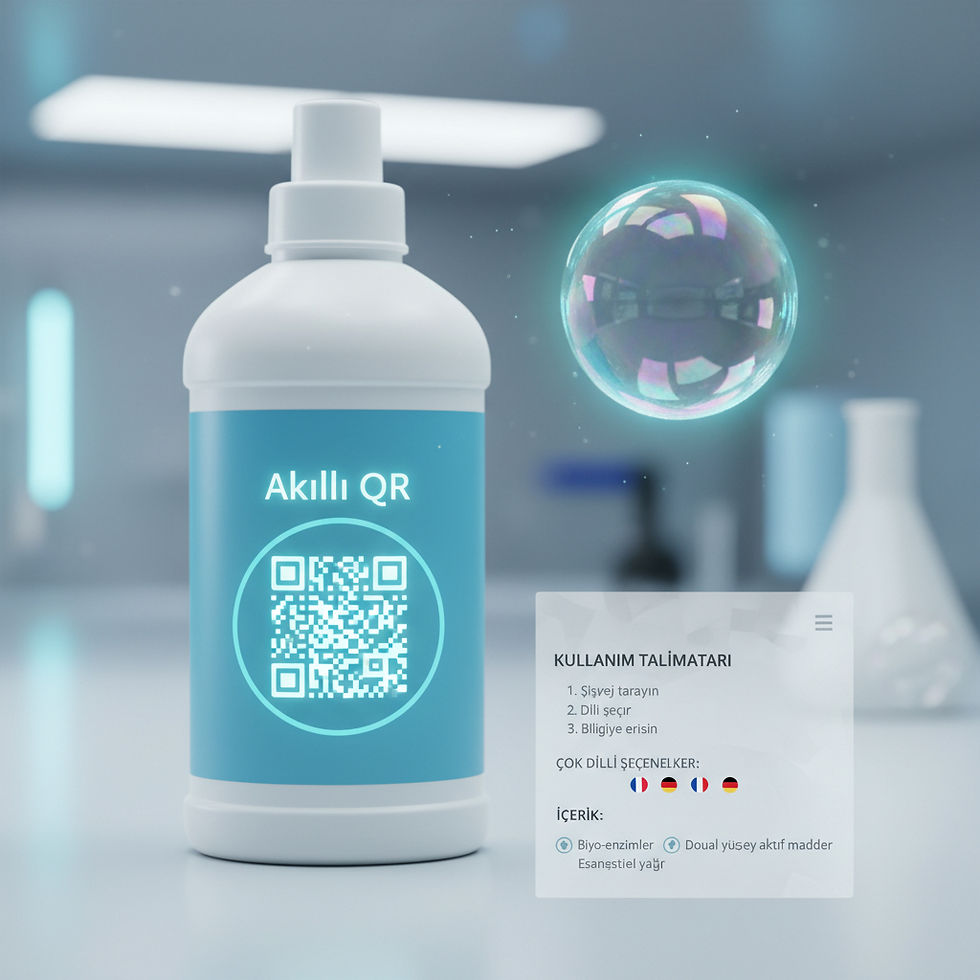
Accessibility: Keep this record publicly accessible throughout the product’s lifetime via a data carrier (QR code, RFID, or NFC).
Important Note: If any of these requirements is missing on the date of your sector-specific delegated regulation, you are not yet compliant.
Tedarik Zincirindeki Rolünüze Göre Sorumluluklar
Uyumluluk süreci, zincirdeki pozisyonunuza göre farklılık gösterir:
Manufacturer Type | Key Obligation | Passport Deadline |
EU Manufacturer | Creates the DPP, assigns an identifier, and registers it in the EU Registry. | Before placing the product on the market. |
Non-EU Manufacturer | Appoints an EU representative or ensures compliance through the importer. | Before the first EU sale. |
EU Importer | Verifies DPP accuracy; becomes responsible if the manufacturer is non-compliant. | At the point of import. |
EU Distributor | Verifies data carrier accessibility. | Before making the product available. |
Retailer | Ensures the code is scannable at the point of sale. | Continuously. |
Critical Dates by Sector
The dates on which the DPP obligation will begin according to your product category are as follows:
Batteries and Accumulators: February 18, 2027
Textiles and Footwear: Mid-2027
Electronics and ICT Equipment: Q1 2028
Furniture: Mid-2028
Construction Products: Early 2029
Iron, Steel, and Aluminum: 2029–2030
8-Dimensional Compliance Checklist
Assess your business across the following 8 key areas to determine your readiness score:
Delegated Regulation Scope: Match your products with the relevant dates. For products falling into two categories, the earlier date applies.
Unique Identification Infrastructure: Create persistent identifiers compatible with GS1 Digital Link and linked to a live endpoint.
Industry-Specific Data Completeness: Prepare data such as carbon footprint and material composition. (LCA studies may take 4–8 months).
Physical Data Carrier: Ensure that QR, RFID, or NFC remains readable throughout the product’s lifetime.
EU DPP Registry Registration: Be ready to register the identifier-endpoint mapping in the central system scheduled to open in July 2026.
Three-Tier Access Control: Establish a system where consumers, businesses, and authorities can access data with different levels of authorization.
Supply Chain Data Collection: Organize data collection processes (API/Portal) and agreements with suppliers.
Continuous Updates: Determine how the DPP will be updated when data changes (such as supplier or material changes).
Data Access Levels
When different stakeholders scan the product code, they see the following data:
Access Level | Who Can Access | Visible Data |
Public (Consumer) | Everyone (QR scanning) | Sustainability, repair, and material summary. |
Economic Operator | Verified businesses | Full product data and conformity documents. |
Market Surveillance | National authorities | All data, including confidential commercial information. |
Frequently Asked Questions (FAQ)
How long does DPP compliance take? A basic DPP can be created within a few days for a product with limited complexity, while the full compliance and data collection process can take 12 to 24 months.
What is the penalty for non-compliance? Products without a DPP cannot legally enter the EU market. Penalties ranging from €50,000 to €500,000 may apply in cases of significant violations.
Which products are covered? The obligation applies to products placed on the market after the relevant date. The point of sale is critical for products already in stock.
This content serves as a guide for your business's digital transformation journey. You can contact us for further information and technical support.
Dpp, Uyumluluk
Digital Product Passport (DPP) Compliance Guide
The Digital Product Passport (DPP), introduced as part of the European Union’s sustainability vision, is no longer an option for businesses but is becoming a legal requirement. This guide outlines the roadmap your business should follow to comply with the new regulations.
More Similar Posts

Dpp, Tekstil
EU Textile Digital Product Passport: A Roadmap for Turkish Exporters Before 2027
