

How Do Product Identifiers Work in Digital Product Passports?
Every Digital Product Passport starts with a simple question: which product are we talking about? The answer requires choosing between three different identification levels — model, batch, or individual unit — and encoding the selected identifier so that it can be read by the QR code, RFID chip, regulatory database, and recycling facility. Making this choice correctly is the foundation for everything else the DPP achieves.
Why Is Identification the Foundation of Every DPP?
A passport without a reliable, persistent, and globally unique identifier is not a passport, but merely a document. The EU’s ESPR regulation explicitly requires the DPP to be linked to the physical product through a data carrier and for this connection to remain functional throughout the product’s entire commercial lifetime. Even when a product changes hands ten times across five different countries over fifteen years, the identifier must still resolve to current and accurate data.
This is not a trivial requirement. Internal part numbers are unique within a company but may conflict across companies. SKUs are unique within a retail system but have no meaning to a recycler. Commercial names change. Companies merge and rename product lines. An identification system for a DPP must be based on a globally unique, registry-backed standard that can withstand all these changes. GS1 identifiers provide exactly that.
Understanding how identification works also clarifies the scope of implementation work when setting up your DPP system. The identification architecture is a decision that simultaneously affects labeling, packaging design, database structure, ERP configuration, and supplier data requirements. This decision needs to be made early.
The Three Levels of DPP Identification
The ESPR regulation and delegated acts being developed for specific product categories define three levels at which a DPP can operate. Understanding the difference between these levels is essential before choosing your identification strategy.
Model Level
At the model level, all physical units belonging to a specific product design share a single DPP. Every washing machine of manufacturer Y’s X model has the same GTIN, and this GTIN points to a single passport containing the material composition, energy class, repairability score, manufacturer information, and certifications.
A model-level DPP is the foundational level. Even in product categories that will ultimately require batch- or unit-level identification, model-level data will remain — a unit-level DPP inherits the attributes of the model-level DPP and adds unit-specific information. For products where the regulation requires identification only at model level (likely including most textile categories), the model GTIN is sufficient as the identifier.
Model-level GTINs use GS1’s Global Trade Item Number standard. GTINs are available in 8-, 12-, 13-, and 14-digit variants (EAN, UPC, ITF-14). For most consumer products, the GTIN-13 seen on retail packaging is the relevant identifier. Manufacturers obtain GTINs by becoming GS1 members in their country; the GS1 member organization assigns a company prefix, and the manufacturer creates GTINs by combining this prefix with product codes of its own choosing.
Lot/Batch Level
Batch-level identification adds another layer of specificity. Products produced in the same production run share a batch or lot number. The batch DPP inherits the model DPP and adds batch-specific attributes: production date and location, batch-specific quality test results, and the specific material suppliers used for that production run (which may differ from the nominal bill of materials when an approved alternative is used).
Batch identification is important for traceability. When a quality issue is detected, the batch number allows you to identify exactly which products are affected and where they are in the supply chain. For regulated products where material composition may vary between production runs — such as food-contact materials, medical devices, and products with variable recycled content ratios — batch-level identification provides the level of detail required by regulators.
In GS1 terminology, a batch is represented as Application Identifier (AI 10) in a GS1 barcode or RFID tag. In a GS1 Digital Link URI, batch information is added as follows: https://id.gs1.org/01/09506000134376/10/ABC12345 — where /01/ indicates the GTIN and /10/ indicates the batch number.
Unit Level — Serialized Identification
Unit-level identification means that every physical unit has its own unique identifier and its own DPP record. This is the most difficult level to implement, but it provides the richest dataset. The DPP of a serialized product may include the assembly date of the relevant unit, the results of the final tests performed on that unit, the repair history accumulated throughout the product’s lifecycle, and, for high-value products, provenance documents documenting the chain of custody from production to the current owner.
One of the first ESPR-adjacent instruments to define DPP requirements in detail, the EU Batteries Regulation requires unit-level DPPs for industrial batteries and electric vehicle batteries. Each battery will need to have a unique serial number, with the DPP associated with that serial number storing state-of-health data, charging history, and ultimately the battery’s decommissioning record.
In GS1 terminology, the serial number is encoded as Application Identifier AI 21. For a serialized product, the GS1 Digital Link looks like this: https://id.gs1.org/01/09506000134376/21/SN-00012345 — the combination of GTIN and serial number is globally unique.
GS1 Digital Link — The Standard That Makes the System Work
Knowing that a product has a GTIN and serial number is not enough on its own. The DPP requirement introduces a function these identifiers historically did not have to perform: resolving to a live and updatable web resource. GS1 Digital Link defines exactly this function.
GS1 Digital Link is a URI syntax standard that embeds GS1 identifiers into a web address. The URI structure is: https://{resolver-domain}/{primary-key-AI}/{primary-key-value}[/{qualifier-AI}/{qualifier-value}]. The domain can be the manufacturer’s own domain or GS1’s resolver service. The path encodes the identifier using AI codes. Optional qualifiers add batch or serial context.
When this URI is encoded into a QR code and scanned, the resolver at the target domain interprets the path and directs the browser to the relevant DPP record. If the browser is a consumer’s phone, a product information page is displayed; if it is a regulatory system, machine-readable JSON data is returned; if it is a recycling facility scanner, dismantling instructions are displayed. The same QR code can serve all user groups through content negotiation by returning different responses based on the Accept header in the HTTP request.
This is a critical architectural point. A product label printed in 2025 may need to serve the correct data in 2040. With GS1 Digital Link, the QR code does not contain the data; it contains an address. The data it resolves to can be updated without touching the label. The identifier on the label is persistent; the DPP content it points to evolves with the product.
Data Carrier Formats
GS1 Digital Link URIs can be encoded in multiple physical carrier formats. Each format has different characteristics suited to different products and use cases.
QR Codes
QR codes are the expected primary carrier for most DPP applications because they can be read by any smartphone without requiring specialized hardware. For consumer-facing products, this is the obvious choice. The QR code must be printed at an appropriate size and resolution for reliable scanning — GS1 publishes minimum size guidelines based on the data density of the encoded URI. For industrial products where the label may be exposed to heat, solvents, or abrasion, durable QR printing technologies such as laser marking, chemical etching on metal, or ceramic printing should be specified.
RFID and NFC
RFID (especially UHF Gen 2 according to ISO 18000-63) and NFC tags can carry GS1 identifiers and are used where QR codes are inconvenient: high-speed logistics lines where line-of-sight scanning is not possible, products with irregular surfaces, or products where label space is insufficient for a readable QR code. NFC is particularly prominent in high-value consumer products (luxury goods, electronics), where a tap-to-verify experience provides a user advantage. GS1’s Electronic Product Code (EPC) standard defines how GTINs and serial numbers are encoded on RFID tags.
Data Matrix and GS1-128
For industrial and regulated products that already use GS1-128 barcodes or Data Matrix codes (common in healthcare and logistics), these formats can carry GS1 Digital Link syntax and support DPP resolution while maintaining their existing functionality. This approach provides a useful transition path for manufacturers that do not want to change their labeling lines — the same carrier format can be expanded to carry the Digital Link URI in addition to existing barcode data.
Identifier Assignment — Practical Steps
If your organization is already a GS1 member and uses GTINs for retail barcodes, your company prefix has already been assigned. The practical steps are: ensure that all products requiring a DPP have a GTIN assigned, create GTINs for products currently identified only by internal codes, and define serial number and batch number formats for categories requiring those levels.
The serial number format is more important than it may initially appear. Some ERP systems assign serial numbers that remove leading zeros. Others use formats containing characters (such as slashes or spaces) that require URL encoding in the Digital Link URI and can lead to scanning errors. Defining URI-safe and consistent serial number formats across all systems, including the ERP, manufacturing execution system, and DPP platform, before implementation can prevent significant rework costs later.
Common Mistakes in DPP Identifier Implementation
The most common mistake is treating the DPP identifier as an IT issue and delegating it entirely to the development team. This is a business decision with regulatory implications. The choice of identification level (model, batch, or unit) determines how data is collected, stored, and maintained for every product within scope. This choice should be made by a decision-maker who understands both the regulation and the operational implications.
The second common mistake is establishing identifier systems that are not globally unique. Internal serial numbers that are unique within a factory but not globally unique are insufficient. If you manufacture in three different countries and assign serial numbers independently at each facility, collisions may occur. The DPP platform will treat these products as the same product. The technical solution is simple — add a facility-code prefix to serial numbers or use UUIDs — but it requires coordination across multiple production operations.
The third mistake is treating the QR code as a label design decision rather than a technical specification. The QR code size, print resolution, substrate material, and durability specification should be determined based on the scanning environment, not simply on how it looks on the packaging. Involve your packaging engineering team in the carrier specification process before the design graphics are finalized.
Identification Support Provided by the Platform
The DPPVisa platform natively supports all three identification levels. When creating a DPP, you can select model level (GTIN only), batch level (GTIN and batch number), or unit level (GTIN and serial number). The platform automatically generates the GS1 Digital Link URI and supports QR code generation with size parameters compliant with GS1 standards. For high-volume serialized products, the bulk API allows you to create hundreds of serialized DPPs from a single template in one call.
The resolver infrastructure ensures that QR codes created today continue to resolve correctly even when the underlying DPP data is updated. For manufacturers that want to host the resolver under their own domain for brand consistency or data sovereignty reasons, a white-label resolver option is available in the Enterprise plan.
Building the identification architecture correctly is a prerequisite for all other processes, such as data modeling, API integration, and compliance reporting.
Frequently Asked Questions
Which unique identifier is used in a digital product passport?
Several types of unique identifiers can be used in a digital product passport, depending on the product category and required identification level. GTINs (Global Trade Item Numbers) are used at the product model or variant level. Serial numbers identify individual units produced. Batch or lot numbers identify production runs. The EU’s ESPR regulation and relevant delegated acts determine which level is required for each product category. GS1 Digital Link is the recommended encoding standard for expressing these identifiers in scannable data carriers.
What is the difference between model-level and unit-level DPP identification?
A model-level DPP is shared by all units belonging to a specific product design — the same GTIN, the same passport. It contains information applicable to every unit, such as material composition, certifications, and manufacturer information. A unit-level DPP is unique to each physical unit assigned a serial number — it includes all the information from the model DPP and adds unit-specific data: the individual serial number, assembly date, test results for the relevant unit, and repair history. Unit-level DPPs are expected to be required for batteries. Textile products will most likely only require model-level identification.
What is GS1 Digital Link and why is it important for DPPs?
GS1 Digital Link is the standard that defines how product identifiers (GTIN, serial number, batch code) are encoded into a URI format that can be embedded in a QR code or RFID tag. When scanned, the URI resolves to a web resource — the DPP record. This standard ensures that a single data carrier can contain both the product identifier and the passport link, and that this link remains functional throughout the product’s lifetime. It serves as the technical bridge between the physical label and the digital record.
Can a batch number be used as a unique identifier in a DPP?
Yes. Batch or lot numbers can be used as a unique identifier for a batch-level DPP — this means that all units produced in the same production run share a single DPP record containing batch-specific data such as production date, production facility, and quality test results for the relevant production run. This approach provides a middle ground between model level (the same DPP for all units regardless of production time) and unit level (a unique DPP for every physical unit). The appropriate level is determined by the delegated act applicable to the relevant product category.
How does a QR code link to a digital product passport?
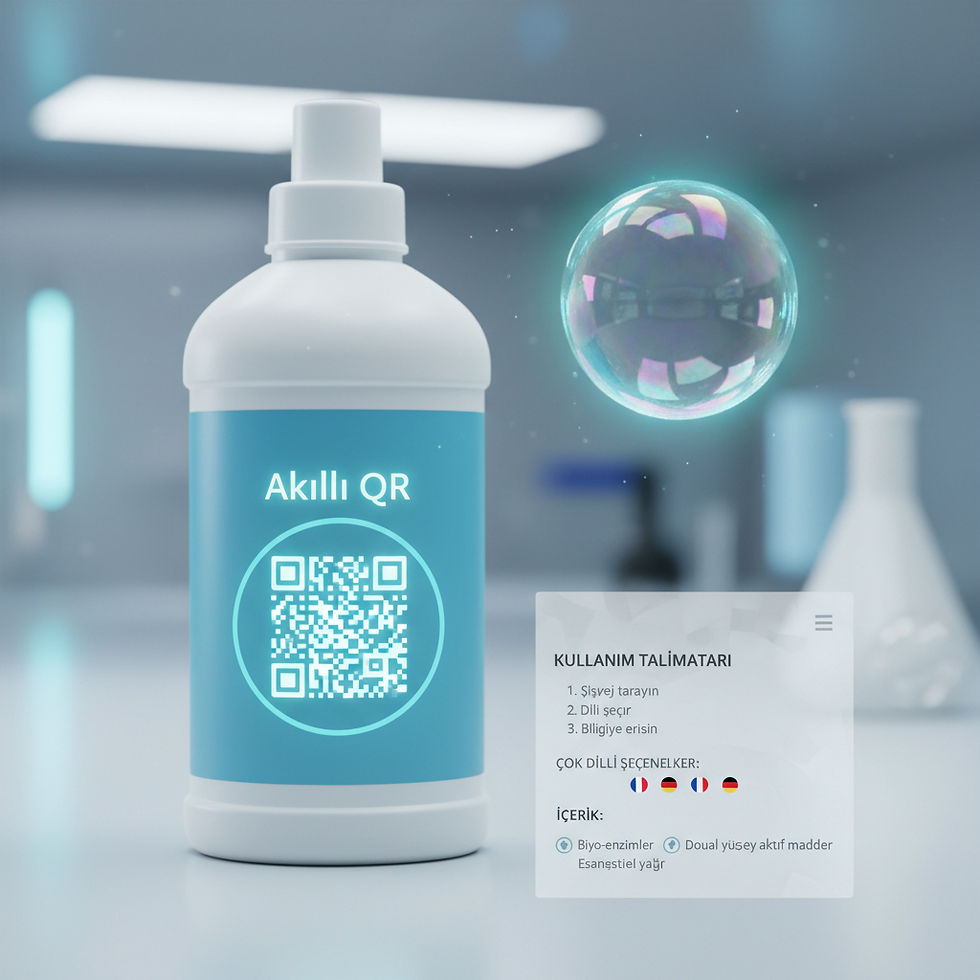
The QR code encodes a GS1 Digital Link URI containing the product’s GTIN and, where applicable, its serial number or batch code. When scanned, the URI resolves to the endpoint defined by the DPP platform for the relevant product or unit. The platform returns DPP data in a format suitable for the scanner — a consumer-friendly web page for smartphones, or machine-readable JSON data for regulatory systems or recycling facilities. The QR code itself does not contain DPP data; it contains the address from which the DPP data can be retrieved.
Short Summary
The foundation of a DPP is a unique identifier that connects the physical product to its digital record. Three identification levels — model, batch, and unit — are selected according to the product category and regulatory requirements. GS1 Digital Link encodes these identifiers into data carriers such as QR codes, RFID, or NFC, creating a reliable and persistent bridge to the passport record. Identification architecture is a strategic decision that affects label design, ERP configuration, supplier data, and compliance reporting, and it should be made at the very beginning of the implementation process.
Dpp, Uyumluluk
What is the DPP Unique Identifier?
GTIN, Serial Number, Batch Code, and GS1 Standards
More Similar Posts

Dpp, Tekstil
EU Textile Digital Product Passport: A Roadmap for Turkish Exporters Before 2027
